
Short answer: a hybrid chatbot uses a traditional, rule-based bot for routine tasks (FAQs, forms, transactions) and hands complex, open-ended questions to LLM-powered agents. A dispatcher decides which path each message takes. You get the reliability and control of structured flows with the flexibility of an LLM. In our implementation, this cut conversation abandonment by 40% and raised successful query resolution by 65%.
Chatbots have come a long way in understanding and responding to user needs, but the journey hasn't been without its challenges. Traditional framework-based chatbots use intent detection, natural language processing (NLP) and predefined flows to handle structured tasks efficiently. However, they lack flexibility for dynamic conversations and need a lot of manual effort to scale and maintain. Pure LLM-based chatbots rely on large language models and the full conversation history to respond. They are highly flexible, but can lack structure and control, and struggle with business logic and integrations.
This post explains how hybrid chatbots are redefining intelligent conversations, through Newtuple's agent-based chatbot design, which combines LLM-powered agents for complex interactions with conventional frameworks. It covers the key components, including dynamic routing, Salesforce integration and AI processing, the measurable improvements in query resolution and speed, and what to consider when building an intelligent, scalable chatbot system.
What changed since the original post (2025): we restored the closing paragraph that was lost when the blog moved to its new home. We also added a note on how the tooling has changed since (Microsoft's Bot Framework SDK has been retired), plus a comparison table and an FAQ.
Understanding the generations of chatbots
Traditional framework-based chatbots
Traditional chatbots rely on intent recognition, NLP and predefined conversation flows to guide interactions. They follow structured dialogue paths with explicit state management, which gives predictable, consistent responses for well-defined tasks like FAQs, form submissions or transactional queries.
These bots excel at repetitive, rule-based conversations, but they lack flexibility with open-ended or dynamic interactions. Any deviation from the predefined paths can lead to rigid or unhelpful responses, which limits their ability to handle complex user needs. Updating and maintaining the conversation logic also takes significant manual effort, so scaling becomes a challenge as business requirements evolve.
Pure LLM-based chatbots
Pure LLM-based chatbots rely entirely on large language models to generate responses. They process conversations by feeding the complete conversation history into prompts, which allows fluid, context-aware interactions that feel natural and adaptable.
These chatbots offer high flexibility, but they can lack structure and control, leading to inconsistent responses. They may also struggle with specific business logic and integrations, because they aren't designed to follow strict rules or work smoothly with external systems. That makes them powerful for open-ended conversations but less reliable for structured, business-critical applications.
Traditional vs pure LLM vs hybrid at a glance
| Traditional (rule-based) | Pure LLM | Hybrid (agent-based) | |
|---|---|---|---|
| Best at | FAQs, forms, transactions | Open-ended conversation | Both, routed per message |
| Consistency | High | Variable | High for routine tasks |
| Flexibility | Low | High | High where it's needed |
| Business rules and integrations | Strong | Weak | Strong, through dedicated agents |
| Maintenance effort | High (manual flows) | Low setup, harder to control | Moderate |
Newtuple's agent-based architecture
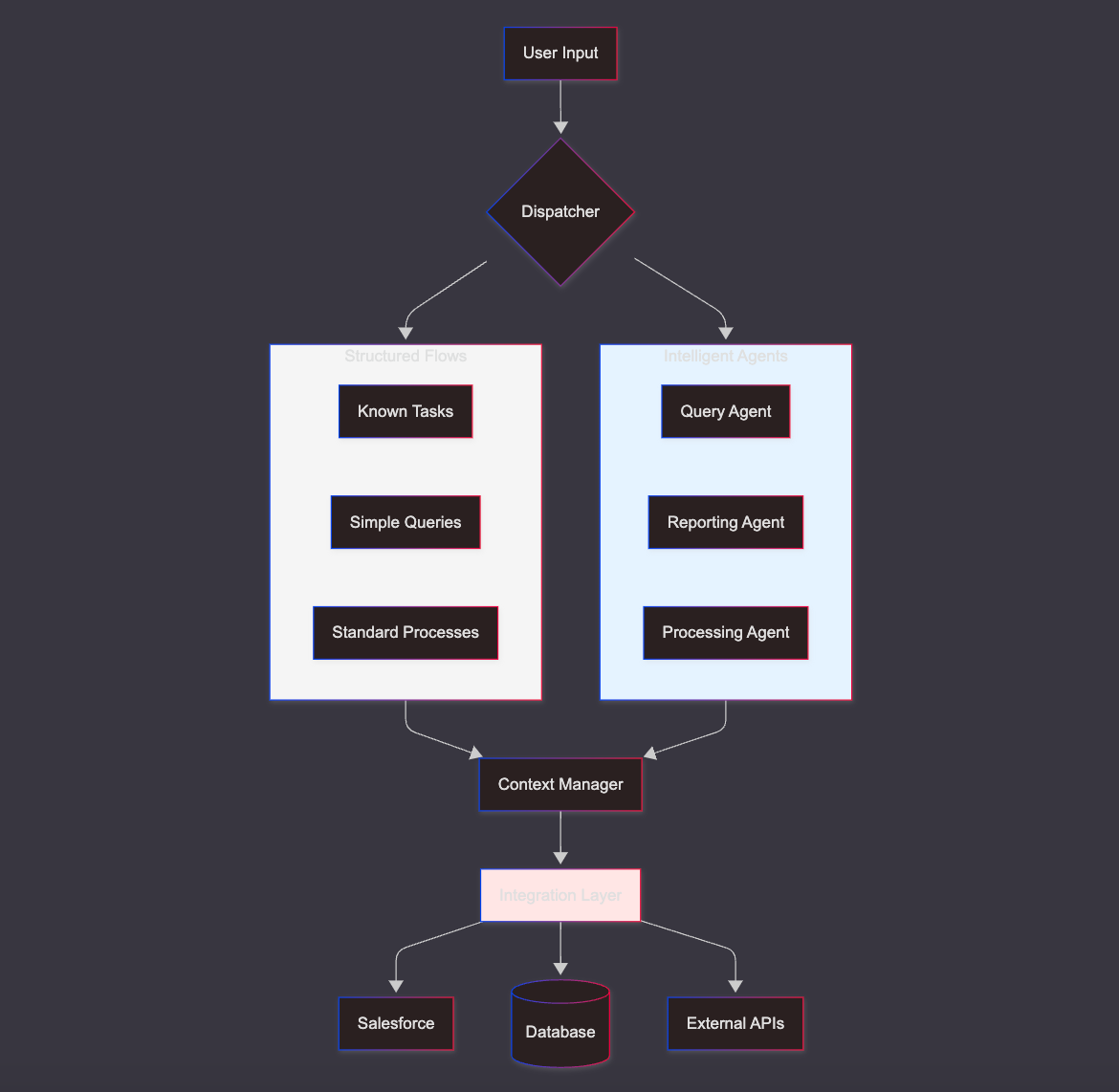 Newtuple's agent-based architecture
Newtuple's agent-based architecture
Newtuple's agent-based architecture
The hybrid agent-based approach
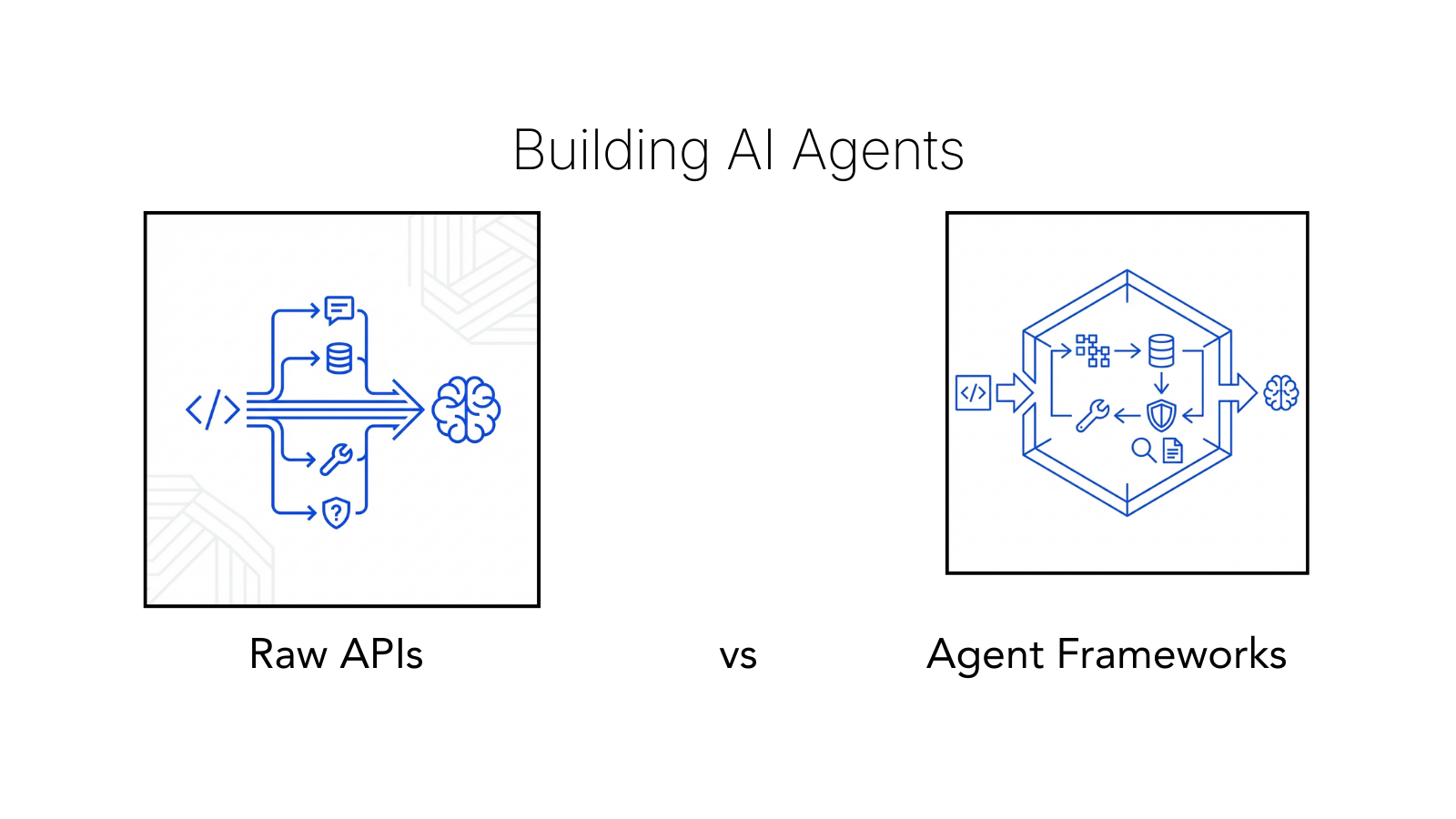
The hybrid agent-based approach combines structured flows with intelligent agents, creating a chatbot system that balances control with flexibility. It uses traditional bot frameworks for structured, rule-based processes, which keeps routine tasks efficient and consistent.
For more complex, context-driven interactions, the system deploys LLM-powered agents that adapt to user input, making conversations more natural and engaging. This hybrid model keeps control over critical workflows while allowing fluid, AI-driven exchanges, so interactions are both reliable and adaptable.
Intelligent agent system
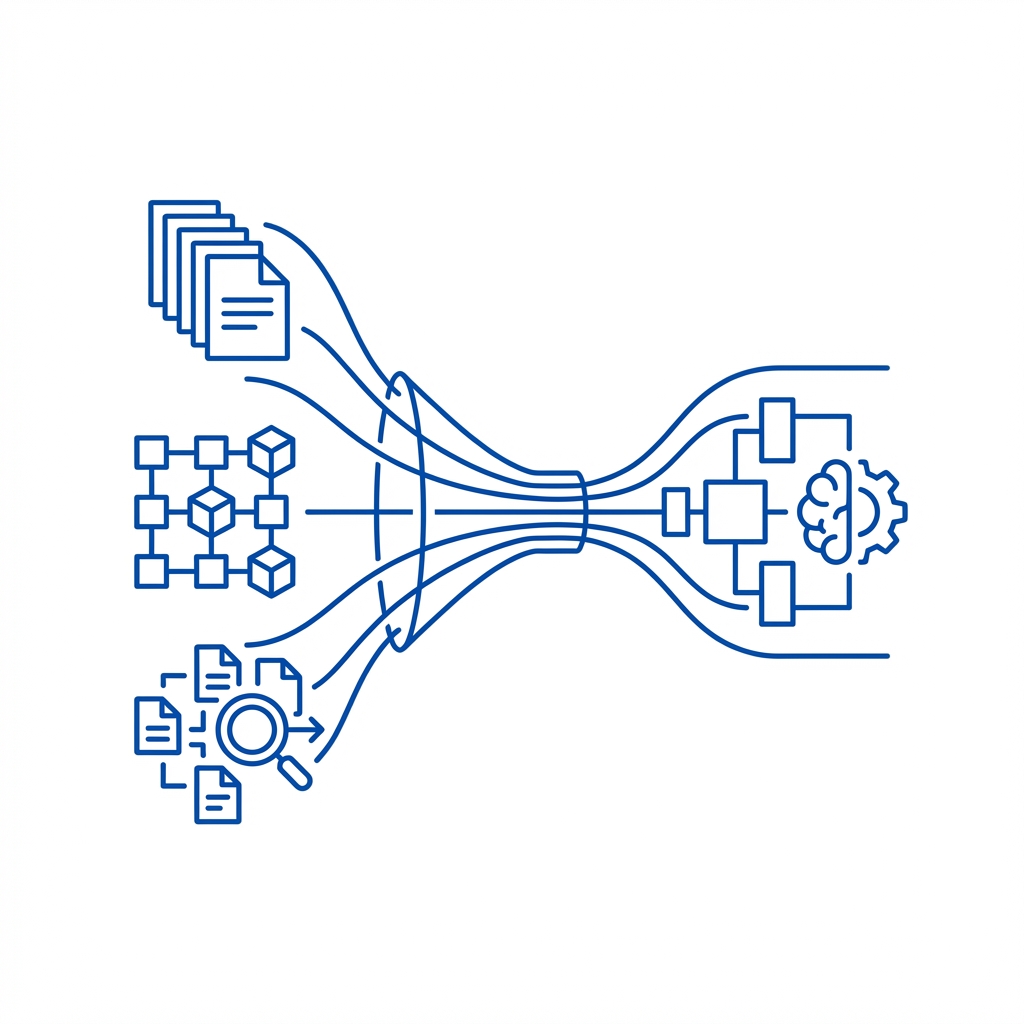
The intelligent agent system manages different kinds of user requests, keeps track of context, and connects smoothly to external systems. By combining dynamic routing, context-aware processing and specialized agents, it gives an effective, scalable solution for complex conversations.
Task-specific agents: specialized agents handle different types of requests, so each domain gets focused expertise. For example, a query agent retrieves information, a reporting agent generates structured reports, and a data processing agent handles calculations and data transformations. This division of work improves accuracy and the overall user experience.
Dynamic routing: an intelligent dispatcher decides whether a request should follow a structured flow or go to an LLM-powered agent. Routine, rule-based queries take predefined paths, which keeps them fast and reliable. More complex, context-driven interactions go to AI agents. This way, neither method is overused.
Context management: agents keep track of the conversation, remember past interactions, and share relevant information between stages. Users don't have to repeat themselves, and conversations stay coherent and natural.
Integration handling: dedicated agents manage interactions with external systems, such as Salesforce, for reading and updating data. By handling API requests and system communication, they give users real-time information without manual steps, which streamlines business workflows and improves accuracy.
Key features and benefits
Dynamic response generation
The chatbot gives real-time, context-aware responses by analyzing past interactions and user intent. Unlike traditional bots, it adapts to what the user says, so conversations feel more natural. It can handle complex, multi-turn conversations while keeping context, which improves accuracy and user satisfaction.
Advanced integration capabilities
Seamless integration with external systems like Salesforce enables real-time data updates and automated report generation. Adaptive Cards provide interactive UI elements for better engagement, and built-in feedback collection helps improve the chatbot over time. The result: smoother workflows, faster responses and more efficient customer support.
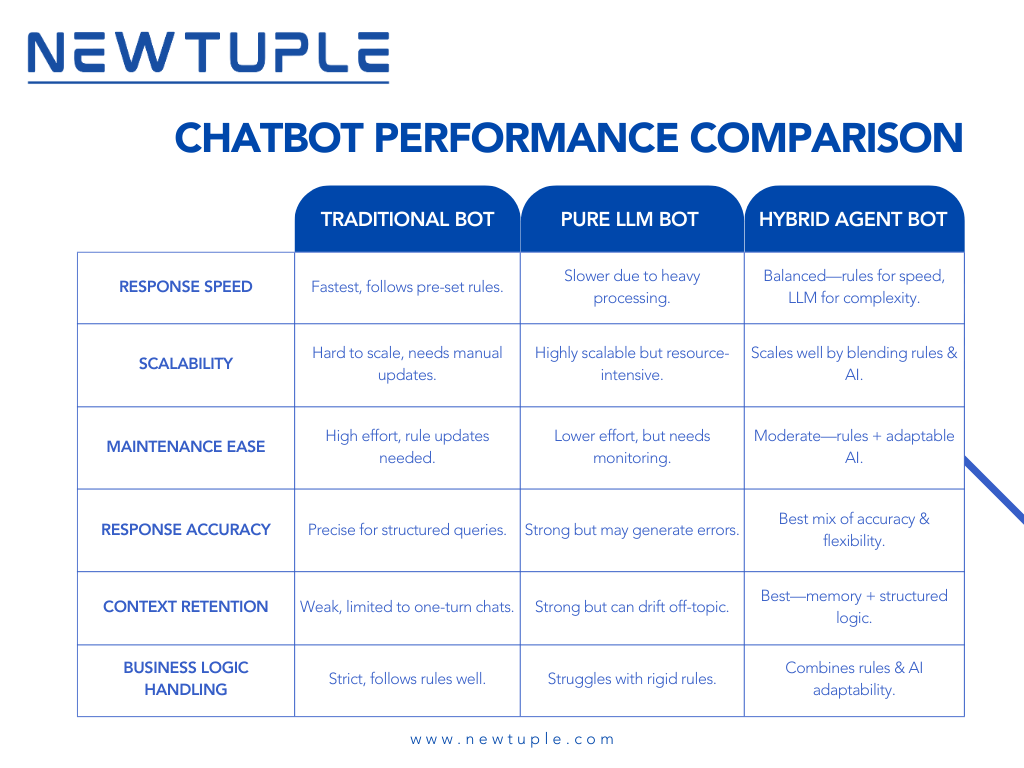 Chatbot comparison chart
Chatbot comparison chart
Chatbot comparison chart
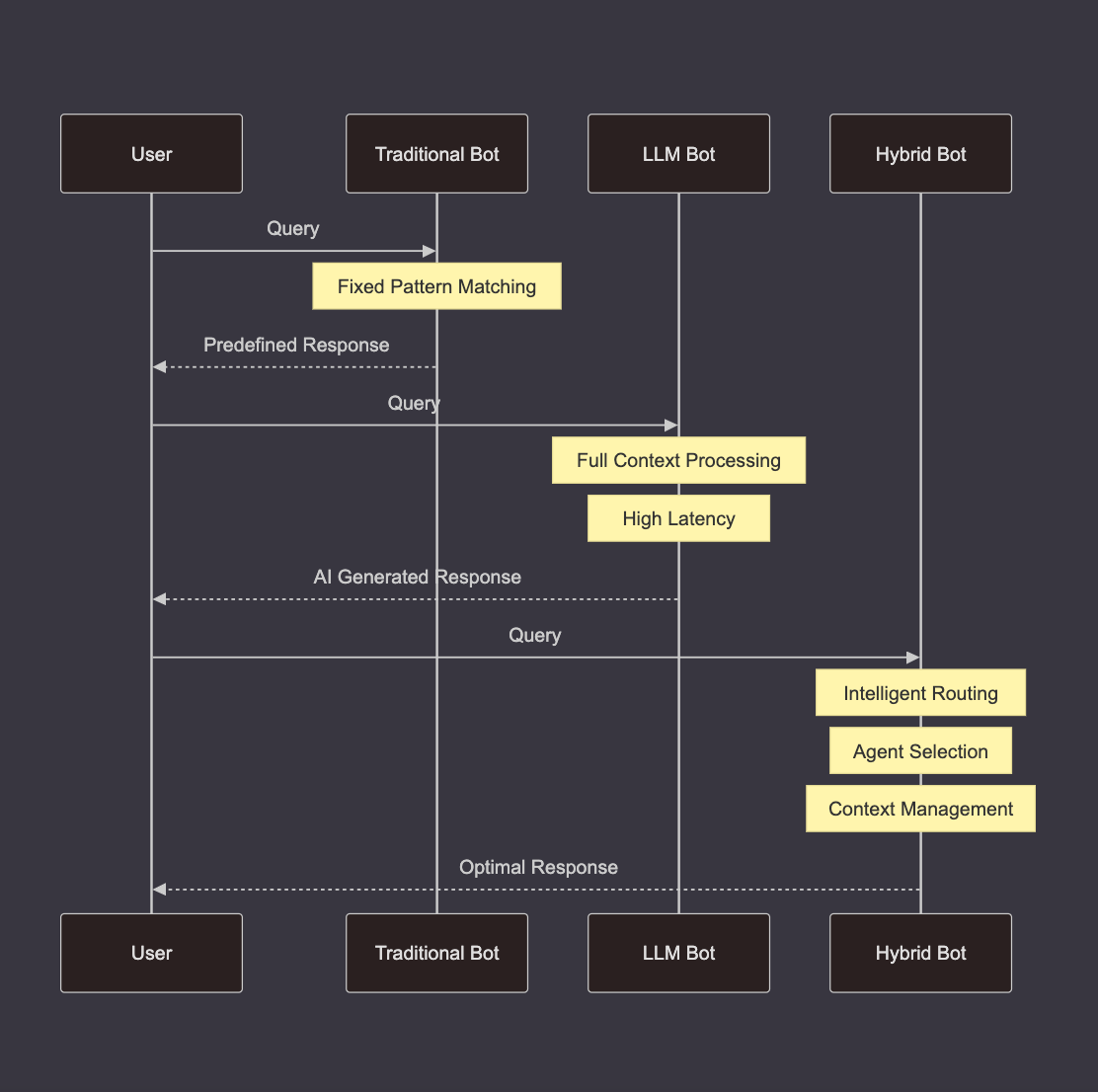 Response processing flow comparison
Response processing flow comparison
Response processing flow comparison
Diving deeper into the technical implementation
The solution uses modern technology to build a robust, scalable chatbot platform.
Frontend layer
The frontend layer gives users smooth, real-time interactions with rich content. It uses the Azure Bot Framework's Direct Line API, which connects the bot to web clients and other channels, so users can talk to it across platforms without disruption.
To improve the experience, the system uses Adaptive Cards for dynamic, visual content: buttons, images and structured responses that make conversations more intuitive.
WebSocket connections handle real-time communication, so messages and responses arrive instantly. Together, these technologies make the frontend responsive, interactive and easy to use.
AI processing layer
The AI processing layer is the intelligence behind the chatbot. It's powered by a custom LLM service that interprets user input, understands intent, and generates coherent, relevant responses, so the chatbot can handle a wide range of questions with a human-like flow.
To keep conversations continuous, the system uses context-aware processing: it tracks past interactions and retains key details across multi-turn conversations. Users don't have to repeat themselves, and exchanges become more personal and meaningful.
Prompt management and optimization through Langfuse fine-tune how the chatbot responds. Refining prompts over time improves accuracy, reduces irrelevant answers and makes the whole system more efficient.
Integration layer
The integration layer connects the chatbot to external systems for real-time data exchange and performance monitoring. Real-time integrations let the chatbot fetch, update and manage customer records instantly, so users always get accurate, up-to-date information. This helps with workflows like lead management, support ticket updates and report generation.
The system also collects analytics and feedback. Insights from user interactions help businesses refine responses, spot common issues and improve performance over time.
Finally, the integration layer includes performance monitoring. It tracks response times and error rates, so issues can be fixed early and the chatbot stays responsive and reliable as the business grows.
Measurable improvements
The hybrid approach led to measurable improvements in both user experience and operational efficiency:
- 40% fewer abandoned conversations, showing higher engagement and better retention.
- 65% more queries resolved successfully, showing the chatbot handles questions more effectively.
- 85% of users gave positive feedback on how natural the conversations felt.
- 50% less maintenance overhead, making the system more scalable and cost-efficient in the long run.
Implementation considerations
Here are the key things to consider if you're planning a similar hybrid approach.
Infrastructure requirements
A strong infrastructure keeps the chatbot fast and lets it scale. You need a robust cloud setup for real-time processing, and a scalable WebSocket architecture to maintain persistent connections for instant messages and updates.
For reliability, you need proper monitoring and logging to track performance, catch issues and optimize response times. LLM hosting and optimization also matter: managing compute carefully keeps AI responses fast, accurate and affordable.
Integration capabilities
The chatbot must connect smoothly to your existing systems. API compatibility allows data exchange with CRMs, databases and third-party services in real time.
To protect users and meet industry standards, build in data protection from the start: encryption, access controls and regular security reviews.
Performance optimization, such as monitoring response times, load balancing and resource allocation, keeps integrations fast and scalable, even at peak usage.
Agent design principles
- Clear responsibilities: each agent handles specific tasks, like queries, data retrieval or reporting, for precise responses.
- Context sharing: agents pass relevant information to each other, so conversations stay coherent and users don't repeat themselves.
- Fallbacks: edge cases are handled by redirecting the request, asking for clarification, or escalating to a human.
- Continuous improvement: the system learns from past interactions to improve accuracy and adapt to changing user needs.
What's changed since we built this
The hybrid approach holds up well, but some of the tooling has moved on since this project:
- Microsoft retired the Bot Framework SDK. Long-term support ended in December 2025, and Microsoft now recommends the Microsoft 365 Agents SDK (or Copilot Studio for a no-code option). Existing bots keep working, but new builds should start on the Agents SDK. Microsoft publishes migration guidance for existing bots.
- Agent integrations are more standard. Protocols like the Model Context Protocol (MCP) now give agents a common way to connect to tools and data sources such as CRMs, which makes the "integration agents" in this design easier to build and swap.
- The core idea hasn't changed. Use structured flows where you need certainty, and LLM agents where you need flexibility, with a router deciding between them.
Looking ahead
The future of conversational AI lies in a hybrid strategy that combines the dynamic, intelligent potential of LLMs with the structured, dependable foundations of traditional systems. This mix gives businesses the flexibility to tailor interactions to their needs, while keeping tight control over conversation flows and LLM outputs. By finding this balance, organizations can deliver reliable, high-quality conversations that keep up with changing needs, and stay flexible in a fast-moving technology landscape.
Final thoughts
Traditional chatbots, built on predefined rules and structured flows, offer reliability and efficiency but often struggle with nuanced, dynamic conversations. On the other hand, pure LLM-based chatbots provide flexibility and natural interactions but can lack consistency, control, and seamless integration with business systems. While each approach has its strengths, relying solely on one can lead to limitations in scalability, user experience, or operational efficiency.
Newtuple's hybrid implementation demonstrates that combining traditional bot frameworks with intelligent agents provides the best of both worlds. Organizations can maintain the reliability of structured flows while leveraging AI-powered agents to handle complex, context-aware interactions. This balanced approach ensures that businesses can automate processes effectively while still delivering engaging, human-like conversations. By blending structure with adaptability, the hybrid model transforms customer interactions while maintaining efficiency, scalability, and control.
FAQ
What is a hybrid chatbot? A chatbot that combines a rule-based bot for predictable tasks with LLM-powered agents for complex, open-ended questions. A router sends each message to the right one.
Why not use just an LLM for the whole chatbot? A pure LLM chatbot is flexible, but harder to control. It can give inconsistent answers and struggle to follow business rules or update systems like a CRM reliably. Structured flows handle those parts better.
How does the chatbot decide between a flow and an agent? A dispatcher looks at each request. Routine requests that match a known flow take the structured path. Anything more complex or context-dependent goes to an LLM agent.
Can a hybrid chatbot connect to Salesforce? Yes. In our design, dedicated integration agents read and update Salesforce records through its APIs, so users get real-time information without leaving the chat.
Want help designing a chatbot that's both reliable and natural? Talk to Newtuple.