
Short answer: no. AI won't replace software engineers, but it is changing the job. AI tools can already write a lot of code, yet designing software, working through requirements with users and owning the architecture still need people. The engineers in highest demand are "AI-augmented" ones: they use AI to move faster while keeping first-principles engineering judgment.
2026 update: two years on. This post was written in March 2024, and we've kept the argument as it was. Since then, AI coding tools have moved from autocomplete and chat to agents that can plan, edit many files, run tests and open pull requests. Tools like Cursor, Claude Code, GitHub Copilot's coding agent and Devin are now part of everyday work for many teams. Benchmarks have jumped too: by mid-2025, even a simple open-source agent scored 65% on SWE-bench Verified, a human-checked version of the benchmark Devin was measured on (so not a like-for-like comparison with the 14% below). Our view is the same, only stronger: the value has moved even further toward specification, review, architecture and judgment. That's exactly where the AI-augmented engineer described below comes in.
The topic of AI in software engineering is quite controversial. People seem to have taken sides on this issue, oftentimes at one of two extremes:
Extreme 1: Software engineering is dead. AI powered by increasingly powerful LLMs will replace all software engineers.
Extreme 2: LLMs are just token predictors. These tools don't understand the context of your application, nor do they create clean, maintainable code. As such, this is just another fad, like the promise of no-code a few years ago.
There are compelling cases to be made for either of these extremes. However, I think the truth is definitely somewhere in the middle.
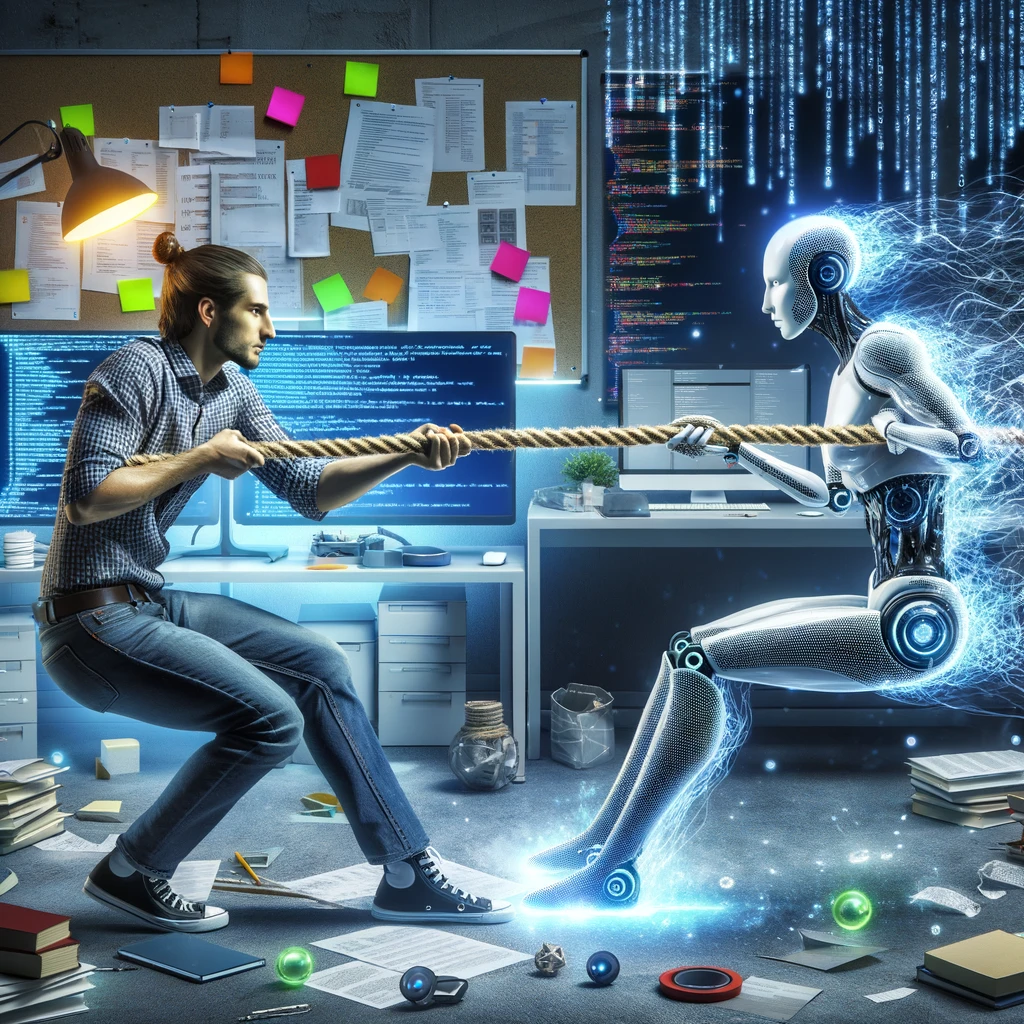 AI and the software engineer
The "AI arms race" is heating up
There is absolutely no shortage of announcements today in the space of code-writing LLMs and SaaS applications that use AI to write code. The most recent one as of this writing (13 March 2024) is Devin from Cognition. Devin promises to provide complete code, end to end, and even claims to solve 14% of GitHub issues assigned to it all by itself. It's incredible. Here's a tool that is laying claim to a very lofty goal: that it can probably already replace junior engineers today.
Apart from this, there are various other releases in the world of AI, from Claude Opus being a fantastic code companion, to Cursor's AI-first IDE (my personal favorite), to GPTs in the ChatGPT store that really do provide fantastic value for developers.
But there's a catch
And that catch is: LLMs and AI apps still need human hand-holding. The design and specifications of the software applications any AI produces today are still necessarily a task for humans. Why? Because developing software is messy, and the actual task of writing code is only one part of the entire process.
So providing a "two-line prompt for creating an app" might give you a very early and (barely) functioning prototype, but that's about it. The application then needs to go through multiple cycles with the end users, and multiple rounds of redesign and redevelopment. Eventually, a competent software engineer will have to get their hands dirty and get into the deep end of the code these tools are churning out.
I love this snippet I've saved from the book "Clean Code". The book is more than 15 years old, but some of this wisdom is timeless.
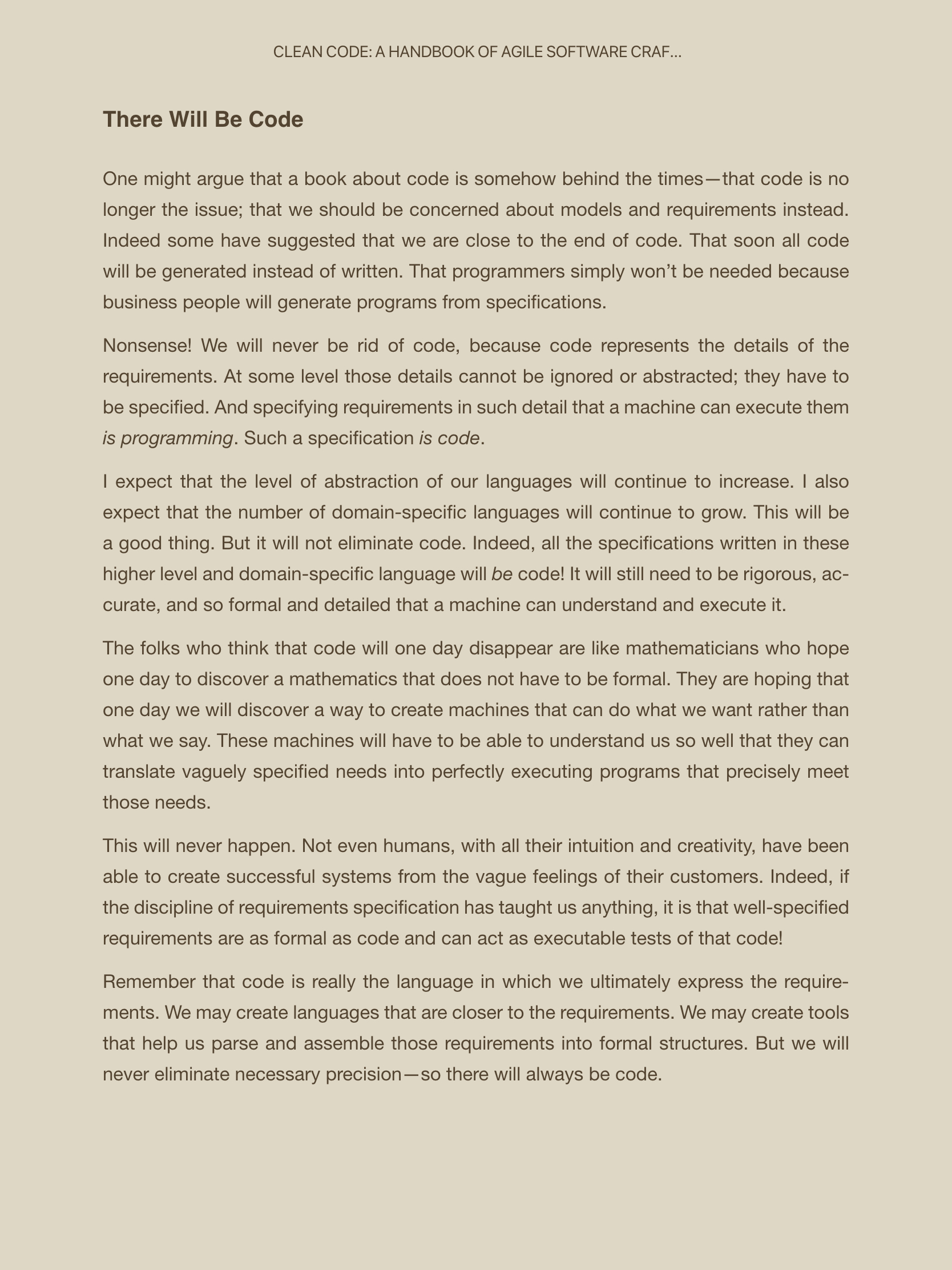 A passage from the book Clean Code
A timeless passage from "Clean Code"
A passage from the book Clean Code
A timeless passage from "Clean Code"
Which brings me to the (un?)happy medium: the AI-augmented software engineer
The happy medium I'm alluding to is where the potential of AI in software engineering truly shines. This is about combining the best of both worlds: the AI-augmented software engineer, which is where the next generation of software engineering is heading.
Can we define it? It's very hard to do in this dynamic landscape, but I'll give it a shot:
"The AI-augmented software engineer is someone who adeptly blends the speed and efficiency of AI tools with a deep understanding of software engineering principles. They use AI to automate the mundane, accelerate development cycles, and bring innovation at a pace previously unimaginable. Yet, they also know that AI is a tool, not a crutch. It's something that enhances their skills, not replaces them. This engineer values the precision of well-crafted code, understands the architecture deeply, and ensures that the AI-generated code fits seamlessly into the broader system, maintaining clarity, maintainability, and scalability."
My guess is that AI-augmented software engineers will be in massive demand over the next one to three years. These are the folks who embrace the power of this AI technology while still developing software with a first-principles approach. In my opinion, this is where the next batch of 10x engineers will come from. If you're a software engineer, new or experienced, you absolutely MUST embrace these tools to enhance your skills and productivity. Not doing so is a recipe for stagnation.
My final conclusion: a call to action for software engineers and software teams
The message is clear: resistance to AI in your software engineering processes is a massive roadblock to progress. Clinging to outdated notions of software development in an AI-accelerated world is a recipe for stagnation. It's time for software teams to foster environments where AI-augmented engineers thrive, blending AI's computational prowess with human ingenuity. Here are some things all software engineers and teams can do:
- Foster AI fluency: cultivate a culture where understanding and using AI tools is as fundamental as coding itself.
- Encourage continuous learning: promote ongoing education in both AI advancements and core software engineering practices.
- Innovate fearlessly: use AI to push boundaries, and encourage teams to explore AI-driven solutions without fear of diminishing their roles.
- Embrace agile evolution: adapt to the rapid pace of AI development, so your teams and technologies stay at the industry's cutting edge.
At Newtuple, we've mandated the use of AI tools for a lot of our software engineering work. Everyone in the team gets paid accounts to the best tools available, and is also free to choose their own tools. For example, some of us love using Cursor, while others like the flexibility of Cursor + ChatGPT Plus, and some others will use VS Code plugins. The constant for everyone is to make use of AI in their development processes. It's an evolving landscape, and it's best to be flexible today.
FAQ
Will AI replace software engineers? Not in our view. AI now writes a large share of routine code, but someone still has to decide what to build, work through requirements with users, design the architecture and review what the AI produces. The job is shifting toward those parts.
What is an AI-augmented software engineer? An engineer who uses AI tools to automate routine work and move faster, while keeping a deep understanding of software design, so that AI-generated code fits cleanly into the wider system.
Will junior developer roles disappear? The tasks junior developers used to start with, like small fixes and boilerplate, are the easiest to automate. Juniors who learn to work with AI tools, and to review and test their output carefully, can take on more meaningful work sooner.
What should engineering teams do now? Give everyone access to good AI tools, make using them part of the normal workflow, and keep investing in core skills like design, testing and code review, which matter even more when AI writes more of the code.
Want help bringing AI into your engineering workflow? Talk to Newtuple.