
Short answer: no. AI can now run analysis, write the code and build charts on its own, but it can't fix bad data, define your business metrics or understand your company's context. As AI makes analysis easier, more organizations want to be data-driven, which increases the need for data professionals. The role is evolving, not disappearing.
2026 update: three years on. This post was written in July 2023, just after ChatGPT's Code Interpreter came out, and we've kept the argument as it was. Since then, that feature has become a standard part of ChatGPT, and AI "data agents" are now built into the major data platforms, such as Snowflake Cortex Analyst and Databricks AI/BI Genie, letting business users ask questions of company data in plain English. The three reasons below have held up well. If anything, point 1 matters more than ever: these agents are only as good as the data models, metric definitions and pipelines underneath them, and building those is data team work.
If you've been keeping an eye on the AI landscape, you've probably come across OpenAI's ChatGPT Code Interpreter, which was released in beta earlier this month. In the realm of data analytics, it's nothing short of impressive. With the capability to parse complex datasets and churn out meaningful insights autonomously, it's hard not to be in awe.
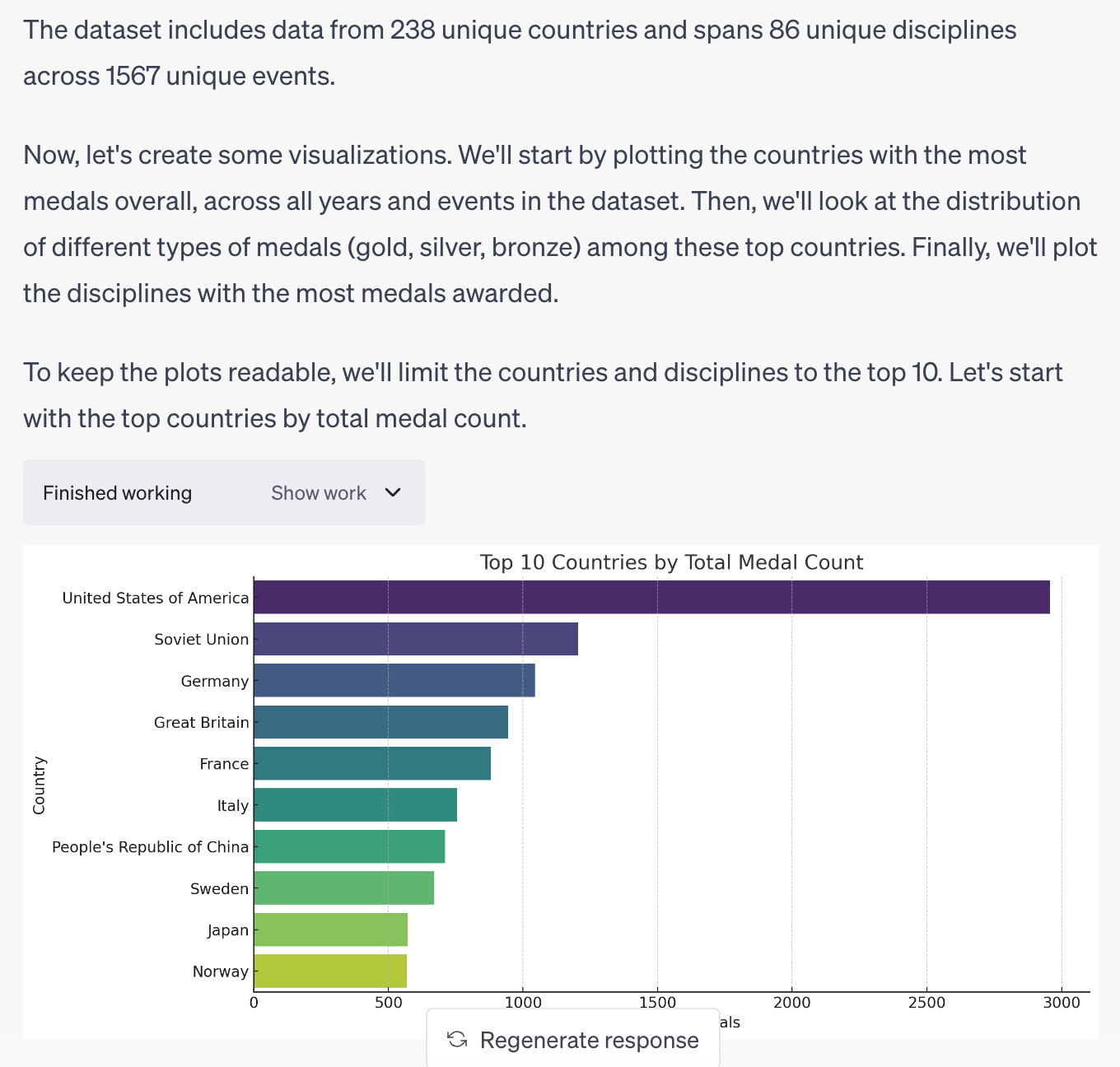
For example, I uploaded a dataset from Kaggle on results from the Olympics over the past 120 years, and it was able to come up with summary statistics on top countries by medal count, the distribution of medals, disciplines and more, with zero prompting effort. On prodding it a bit more, it provided meaningful comparisons between countries and additional trends. All of this with working Python code and a set of visualizations that would take someone hours to days to do! It is fascinating how a language model that is primarily based on predicting the next character can do really intelligent data analysis like this. It even created custom metrics such as "medal efficiency", describing it as the number of medals won divided by the number of events participated in!
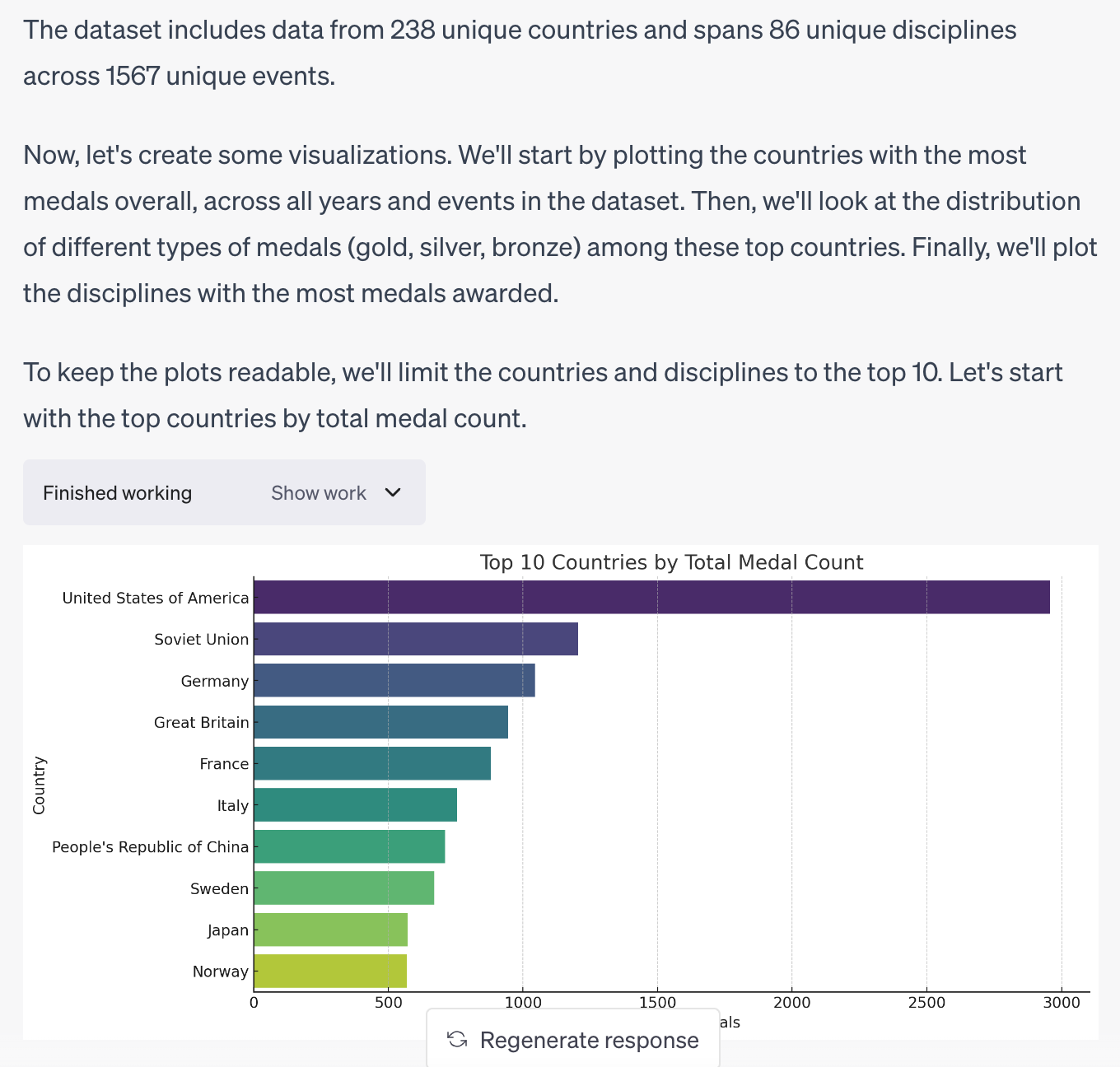 Code Interpreter's summary of the dataset and a chart of the top 10 countries by medal count
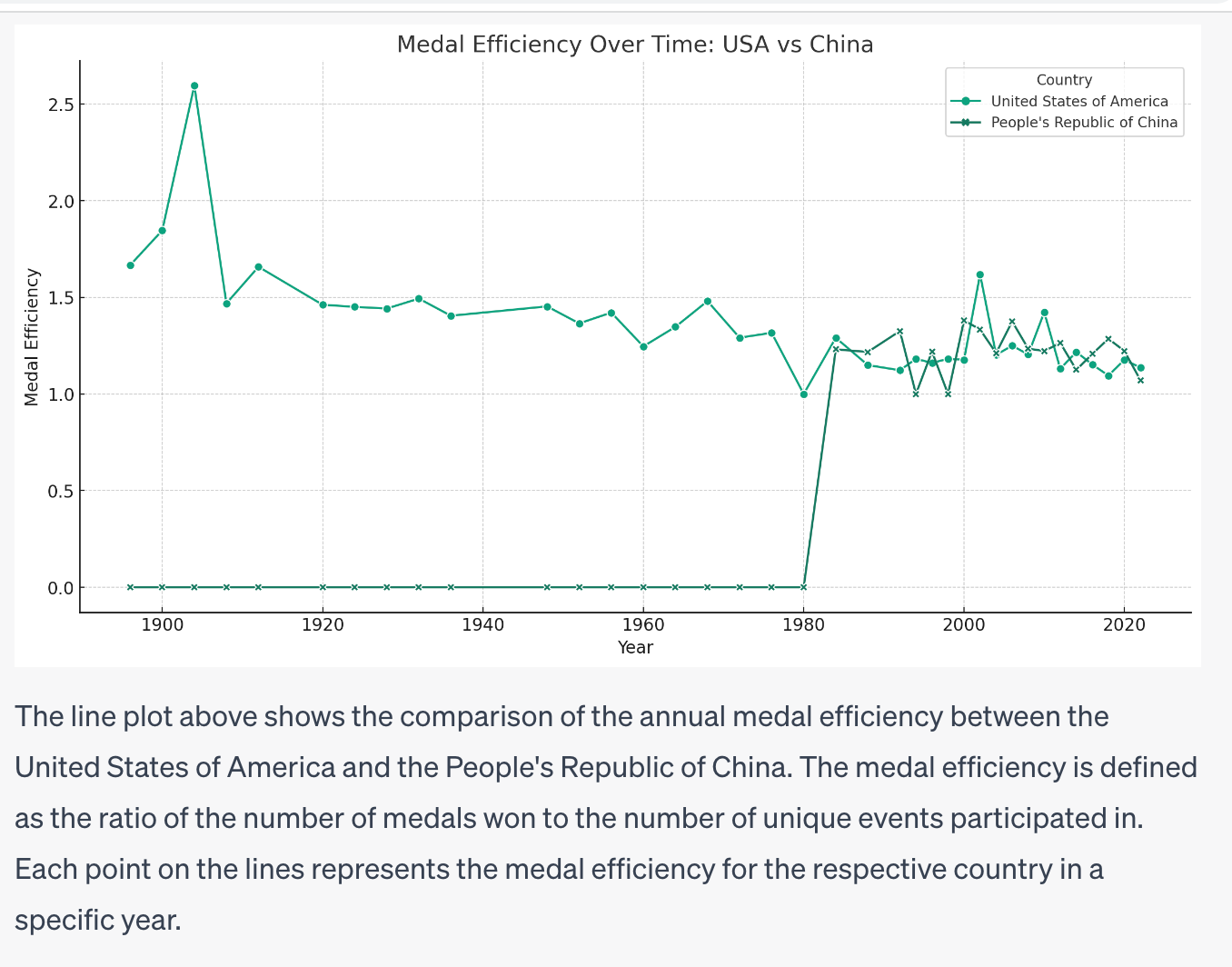 Code Interpreter's "medal efficiency" chart comparing the USA and China over time
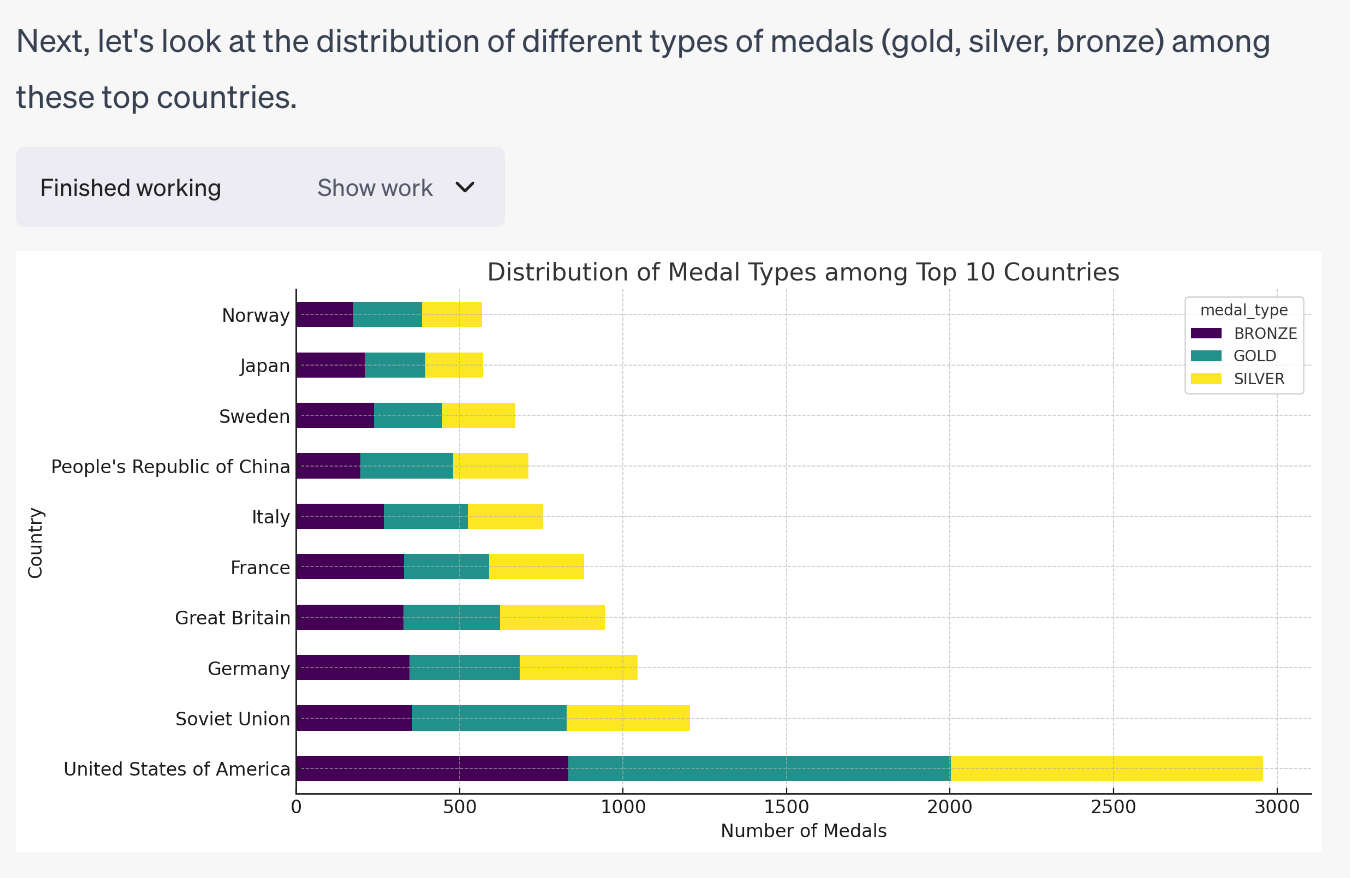 Distribution of gold, silver and bronze medals among the top 10 countries
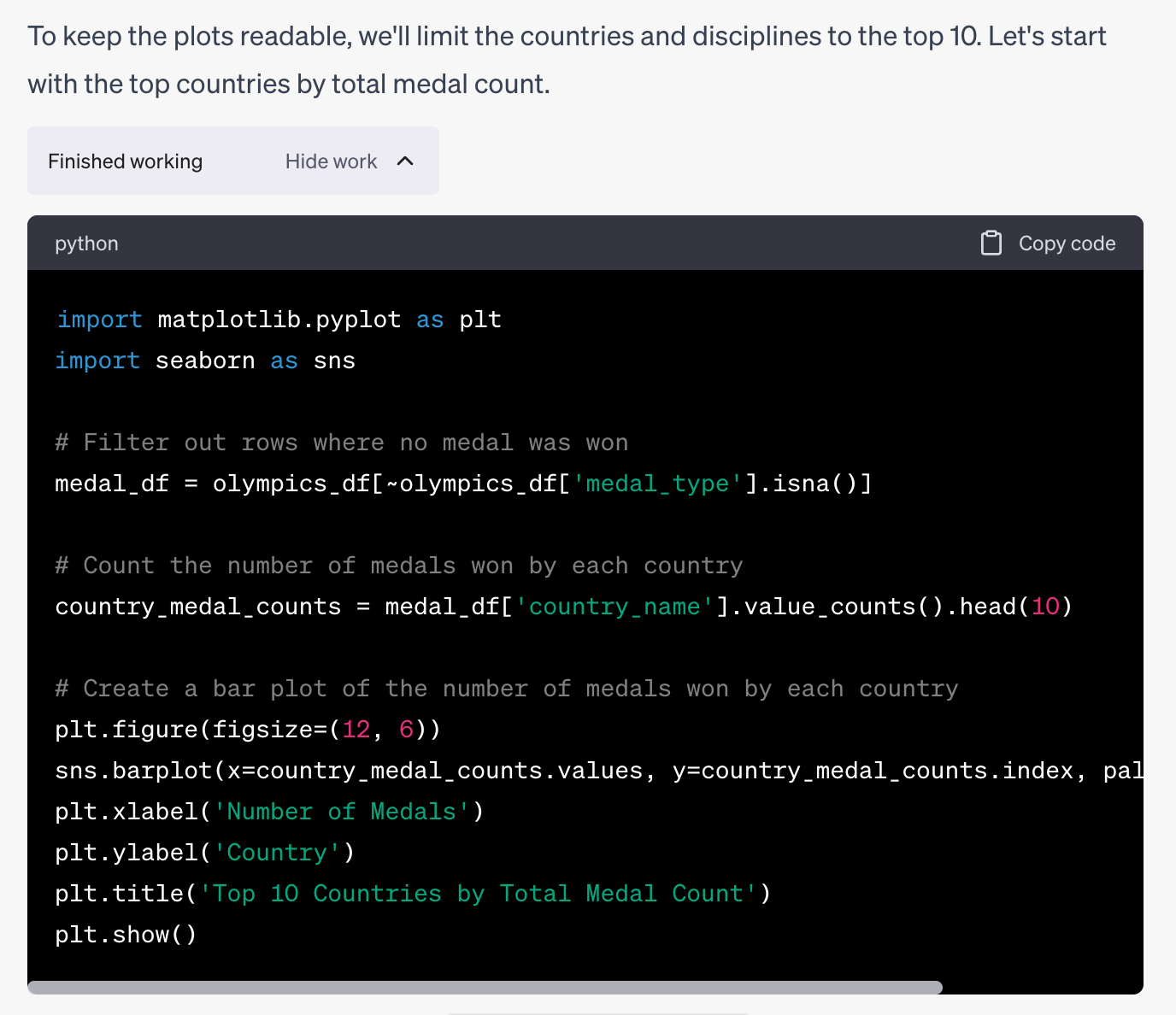 The Python code Code Interpreter wrote and ran for the analysis
Screenshots from our 2023 test of ChatGPT's Code Interpreter on an Olympics dataset
The Python code Code Interpreter wrote and ran for the analysis
Screenshots from our 2023 test of ChatGPT's Code Interpreter on an Olympics dataset
So here's what Code Interpreter can already do: it can generate insightful reports and visualizations that could take a human analyst a significant amount of time to piece together. It can also run summary statistics, allow for a seamless conversation with your data, and more. It autonomously debugs and rewrites code with no supervision and comes up with conclusions. Watch this space: the pace at which these tools are being rolled out will change the way we look at data forever!
With such rapid advancements, it leads to the natural question: is the era of the human data team winding down?
I don't think so. I don't see this as a countdown to obsolescence for our data experts. On the contrary, I believe it's opening the door to a new, transformative phase for data analytics.
Here are some reasons why.
1. Garbage in, garbage out
The long-running saying "garbage in, garbage out" will be amplified when it comes to AI-driven data analysis. Poor-quality data, poorly developed data pipelines and unclear definitions of business metrics will directly hurt the quality of analysis, whether it's human-driven or AI-assisted.
You still need to have your data pipelines in order. Before you "hand off" your data to an AI to interpret, you have to make sure your data is accurate, clean and up to date. This is a set of tasks that requires specific domain knowledge and, more importantly, specific organizational knowledge. It may be time to start reconsidering the approach of running a company on the basis of 35 Excel files on someone's computer!
2. Lower barriers to entry = more demand for data professionals
As data analysis becomes more accessible, more organizations will aim to become data-driven. This will INCREASE the need for data analysts, not reduce it.
With AI simplifying basic data analysis, more organizations are waking up to the strategic importance of being data-driven. Companies that once relied heavily on instinct or "gut feel" are now recognizing the value of empirical, data-supported decision-making. This shift will create a swell of demand for data professionals who can navigate the complexities of this transition.
Moreover, as data-driven decision-making spreads through an organization, there's a growing need for professionals who can provide the right training, support and guidance to non-technical staff. The need to interpret and communicate the implications of data-driven insights, and to guide strategic and operational decisions, is more important than ever.
3. Data engineering and analysis still need significant human oversight
It's crucial to remember that getting real value from data isn't simply a matter of feeding information into an algorithm. The process requires a depth of understanding and a breadth of skills that, at least for now, are uniquely human.
Transforming raw data into valuable insights takes technical expertise, such as in-depth knowledge of data modeling, data cleaning, ETL processes and sophisticated analytical methods. It also takes a deep understanding of the specific business context the data comes from. An AI might identify patterns and trends, but understanding why those patterns exist, interpreting what they mean for your organization, and using that knowledge to drive strategic decisions requires a human touch.
So what should data teams do?
For anyone working with data or running data teams today, there are three approaches you can take:
- Shun these tools completely, and keep working the way you have for years. (Hint: this is a recipe for disaster.)
- Embrace the power of tools like Code Interpreter and accelerate your data team's productivity immediately.
- Develop your own custom, AI-augmented data analysis tools by using these LLMs and giving them the context of your own organization's data and use cases. (And if you're looking for help with this, reach out to us in the Newtuple team.)
I know I'm oversimplifying the options, because there are real considerations like data security and privacy, and even more nuanced ones like data quality. But if you take a step back, it really does seem like this is a moment in technology where those who adopt it will have exponential benefits over those who don't.
Imagine a data analyst in your team who can harness these models today. They'll be able to build analysis on datasets in maybe a quarter of the time it used to take, and provide more in-depth work in that time. Your data team can become more productive immediately if they use these tools the right way.
The role of the data professional is evolving, not disappearing, and human oversight and expertise will remain paramount. The combination of AI and human acumen, it seems, is set to be the gold standard for extracting the most value from our ever-growing volumes of data.
If you're looking for advice on how best to use AI-assisted analytics in your organization, do reach out to us. We're already working with our clients to help them navigate the explosion of AI tools. There's no one-size-fits-all solution: some organizations may be better off using off-the-shelf large language models, while for others there's a real case for developing an organization-specific AI data analytics tool, with all the bells and whistles of data security and, if required, even custom model deployment.
FAQ
Will AI replace data analysts? Not in our view. AI takes over much of the routine work, like writing queries and building first-draft charts, but people are still needed to make sure the data is right, define the metrics, and turn results into decisions that fit the business.
What can AI data analysis tools do today? They can load a dataset, write and run code to analyze it, produce summary statistics and charts, and answer follow-up questions in plain English. Many data platforms now include these features directly.
What skills should data professionals focus on now? Data modeling, data quality, clear metric definitions, business understanding and communication. These are what make AI analysis accurate and useful, and they're hard to automate.
Should we build our own AI analytics tool or use an off-the-shelf one? It depends on your data, security needs and use cases. Off-the-shelf tools are a quick start. A custom tool makes sense when you need it to understand your own data models and business context, or to meet strict security requirements.
Want help using AI for analytics in your organization? Talk to Newtuple.